

Matlab for Signal Processing - Lesson 01
- Grigoris Athanasiadis
- 22 Οκτ 2017
- διαβάστηκε 2 λεπτά

MATLAB is a commercial software product available from The Mathworks. It consists of a main “engine” to perform computations, and several (optional) extended - function libraries (called “toolboxes” ) for special - purpose applications. The main MATLAB engine has many robust mathematical functions built - in. It is an interpreted language — meaning that each line of source is parsed (analyzed and converted) in text form, without being converted into a native machine code executable. This means that it may be slower to execute the given code in many circumstances than equivalent code written for a specific processor.
It is worth noting that DSP systems are often developed in MATLAB, and implemented on the target hardware using the C language. This is because MATLAB provides an easier environment in which to design and test algorithms, and the so - called “target” devices (the end - product) often have limited memory, display, or other constraints. The C language (and by extension, C++ ) is able to produce assembly language code for target processors, which is optimized for that particular device ’ s instruction set. The MATLAB syntax is, in many ways, somewhat similar to the C programming language.
MATLAB may be used interactively or in a “batch” mode for long computational scripts. Simply typing “help” at the command prompt provides assistance with various features. MATLAB has a rich set of constructs for plotting scientific graphs from raw or computed data, suitable for inclusion in reports and other documents. One particular advantage of MATLAB is that it is available on several different computer operating system platforms. This text makes no assumption about the particular version which is available, and does not assume the presence of any toolboxes.
Everything is a matrix
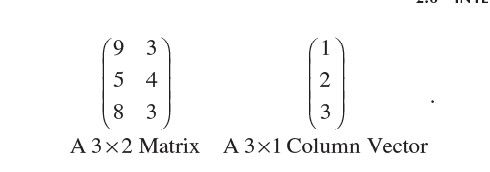
MATLAB may be used from the interactive window, and does not require variables to be declared, as in many procedural languages. Simply typing the name of the variable prints its value. One very important distinction is that all variables are matrices — a scalar (single value) is just the special case of a 1 × 1 matrix. A vector is of course a matrix with one dimension equal to unity. By convention (as in mathematics), vectors are assumed to be “column vectors ” — that is, of dimension N × 1 ( N rows in one column). To picture this, we might have:


Σχόλια